Skip to content

Historical context

Calle San José and the Huerta de Alicante

The history of Calle San José in Sant Joan d'Alacant connects with Benialí, the Huerta de Alicante, the historic irrigation channels and the protection of the old town. This page helps to understand what the historic urban core is and why its protected boundary matters today. Calle San José is not just a street: it is the origin of Sant Joan d'Alacant and a living part of a cultural landscape with over nine centuries of history — the Huerta de Alicante.

Heritage in figures

+500

Years of Calle San José

1696

First graphic representation of the street

3,800

Hectares of the Huerta de Alicante

150

Catalogued buildings in the Huerta

56

BIC and BRL assets in the Huerta

22

Historic irrigation arms

1244

Christian conquest of Benialí

1580

Start of the Tibi Dam

1696

First representation

The first documented graphic image of the street dates from 1696. Earlier even than the expulsion of the Moriscos (1609).

PB+2

The right height

The current plan sets ground floor + 2 storeys (3 floors). The height that respects the 17th-century historic fabric.

PB+2+penthouse

What MP25 wants

A fourth floor with +2,200 m² of unforeseen penthouses. A 15-metre blank wall over the old town.

60 days

vs 500 years

MP25 was processed in ~60 days. The street has been standing for over 500 years.

§ 01

The Huerta de Alicante

The Huerta de Alicante is an alluvial plain of around 3,800 hectares north-east of Alicante, covering Alicante, Mutxamel, Sant Joan d'Alacant and El Campello. Its origins go back at least to the Islamic period, and its territorial structure has been shaped over more than nine centuries by three elements: settlements, paths and the irrigation system.

The Tibi Dam (1580–1594), one of the oldest hydraulic engineering works in Europe still standing, transformed the Huerta by allowing the regulation of the Montnegre river. From the reservoir, water is distributed by eleven channels, the main one being the Acequia Mayor or del Consell, which crosses the entire Huerta. From it 22 arms and dozens of secondary channels (hijuelas) water every plot.

Precisely one of those secondary channels —the Hijuela de Mingot— runs beneath the plot at Quijote 12, the epicentre of Modification 25. The hydraulic infrastructure that has watered the Huerta since the 16th century literally crosses the very land they want to amend.
§ 02

Benialí: the original name

Before being called Sant Joan, our town was known as Benialí or Benalí, a place name of Islamic origin that was kept until 1244, when the lands were taken by the future king Alfonso X the Wise. The original mosque was consecrated to Saint John the Baptist, and the name spread to the whole town.

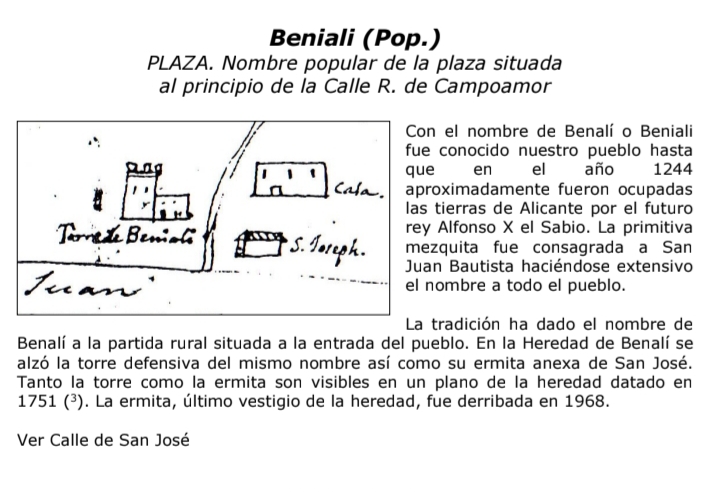
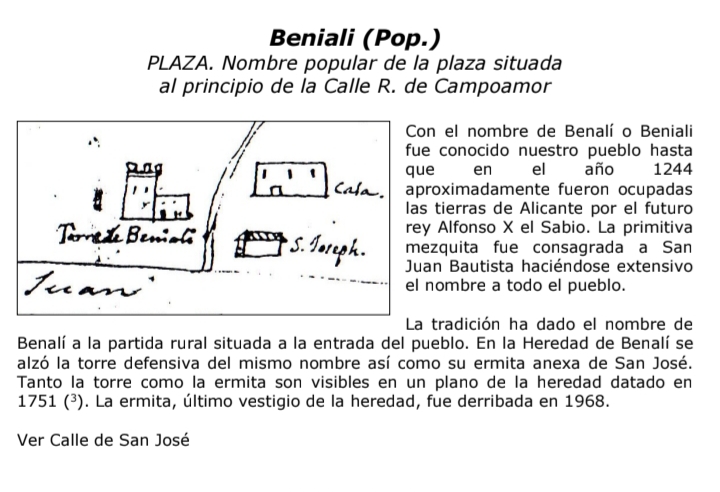
On the Heredad de Benalí estate stood a defensive tower of the same name and its annex chapel of San José. Both the tower and the chapel are visible in an estate plan dated 1751. The chapel, the last vestige of the estate, was demolished in 1968.

This document, published by the Town Hall of Sant Joan d'Alacant itself, confirms that Calle San José is the founding heart of the municipality. The historic plan clearly shows the Tower of Benialí next to the reference «S. Joseph», proving that the street and its surroundings predate even the current name of the town.

Document on the origin of Benialí. Historic plan with the Tower of Benialí and the «S. Joseph» reference.
Municipal publication on Benialí. Reinforces the origin of the town and Calle San José tied to the Heredad.

§ 03

Sant Joan and Calle San José

Sant Joan d'Alacant is one of the road-side towns of the Huerta, born along the main communication routes and crossroads. Its founding core developed from the church and a small hamlet arranged along the paths, like Calle San José.

The first dwellings of what is today Calle San José were built around ~1510, in full expansion of the Huerta after the construction of the Tibi Dam. The street predates the publication of Don Quixote (1605) and the expulsion of the Moriscos (1609), and its first graphic representation dates from 1696.

The neighbours of this street were, for centuries, the farmers and craftsmen who worked the immediate Huerta plots: they grew vines, almonds, carobs and fruit trees. They were the hands that kept the irrigation system, channels and arms alive. Calle San José is not an urban accident: it is the very origin of the municipality.

§ 04

Fondillón wine

The Huerta de Alicante was historically famous for its vineyards. Already in the 17th century, the chronicler Bendicho highlights vine cultivation as one of the most notable productions, even noting the replacement of olive groves with vineyards because of higher profitability.

From these vineyards came Fondillón, an oxidative-aged wine made from over-ripened Monastrell grapes, regarded as one of the great historic wines of Europe. Appreciated at the courts of Louis XIV of France, mentioned by Alexandre Dumas in The Count of Monte Cristo and exported throughout Europe, Fondillón was the pride of the Alicante Huerta.

The cellars of the Torres de la Huerta —many of them declared Cultural Heritage Assets— were the place where this wine was produced. The neighbours of Calle San José, as Huerta farmers, took part for generations in the vine growing and wine production that gave international fame to these lands.

§ 05

The Towers of the Huerta

The Towers of the Huerta still stand: 16th-century defensive constructions raised against attacks by Berber pirates. These towers, declared Cultural Heritage Assets, are intimately tied to agricultural use: next to each tower stood a dwelling with an oil mill and a wine cellar.

The municipality of Sant Joan d'Alacant has 4 BIC and 15 BRL in its heritage catalogue. In the entire Huerta there are 150 catalogued buildings, of which 56 are BIC or BRL. This means that in an area representing barely 1.2% of the territory of the four municipalities, 45% of their highest-value heritage assets are concentrated.

§ 06

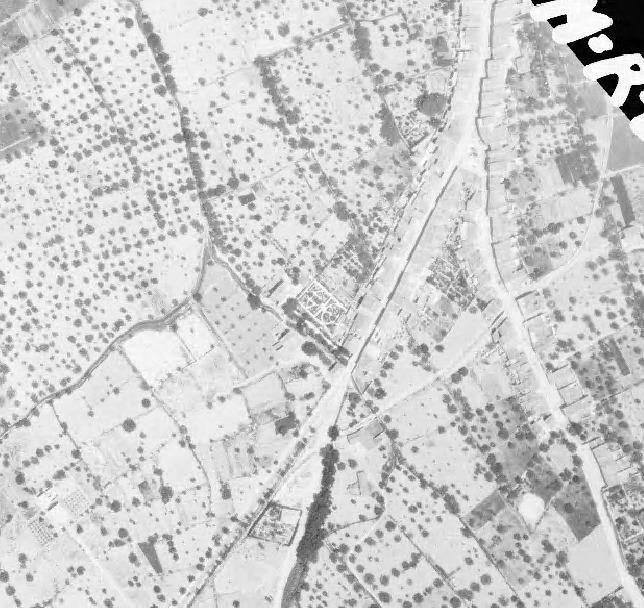
The Huerta from the sky (1956)

This aerial photograph from the «American Flight» of 1956 shows the landscape of the Huerta de Alicante before the rise of urban developmentalism. The agricultural plot structure, rural paths, channels and scattered trees —almonds, carobs and vineyards— that defined the territory for centuries can be clearly seen.

In this image one can observe how the urban core of Sant Joan d'Alacant was still a small hamlet surrounded by cultivated fields, with Calle San José as the backbone of the town. The contrast with the current situation —where concrete has replaced the fields— is the best proof of what academic research describes as an «unprecedented transformation» of the cultural landscape.

American Flight (1956). The Huerta de Alicante before developmentalism: plots, paths and channels intact.

§ 07

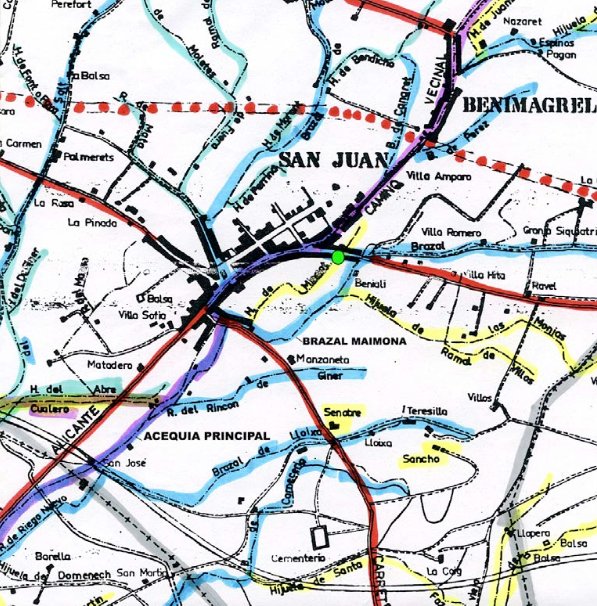
The paths of water

The Huerta's irrigation structure is a hydraulic system of medieval origin perfected over centuries. From the weirs of Mutxamel and Sant Joan (both BIC), water is distributed by the Acequia Mayor and the Gualeró, which join just before entering the urban core of Sant Joan d'Alacant.

The 22 arms branching from the main channel water plot by plot the entire Huerta. The paths of water have been, for centuries, also the paths of people: channels and trails interweave forming a network that has structured and ranked the whole territory until the irruption of contemporary urbanism.

As academic research notes, the territorial organisation of the Huerta was for centuries a «slow process respectful with its own past», incorporating previous legacies without abrupt ruptures. That historical continuity was dramatically broken from the 1970s onwards by urban developmentalism.

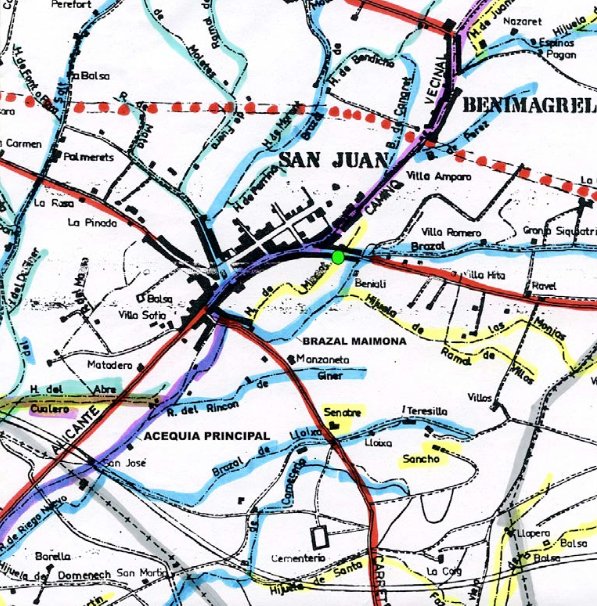
Irrigation plan of the Huerta passing through Sant Joan d'Alacant. ■ Main channel · ■ Arms · ■ Hijuelas · ● Hijuela de Mingot (Quijote 12 plot).
Historic map of channels. Locates Sant Joan, Benialí and the irrigation network that articulated the territory for centuries.

§ 08

The current threat

Partial Modification No. 25 of the Sant Joan PGOU seeks to alter the urban conditions of the Quijote 12 plot, located behind the historic dwellings of Calle San José, in the heart of the Old Town (BRL zone). A plot crossed by the Hijuela de Mingot, part of the 16th-century irrigation system.

While academic research documents that in the Alicante Huerta there has been an «unprecedented transformation that has meant the disappearance of agricultural activity and the degradation of a cultural and heritage landscape of high value», the Sant Joan Town Hall pushes an express urban modification that puts the oldest dwellings of the municipality at risk.

Did you know…?

Fondillón is one of the Spanish wines with its own historic appellation. Its production almost disappeared in the 20th century, but today it is experiencing a renaissance thanks to wineries recovering the ancestral techniques of the Huerta. The same hands that watered these lands with water from the Tibi Dam produced one of the most celebrated wines in the history of Europe.

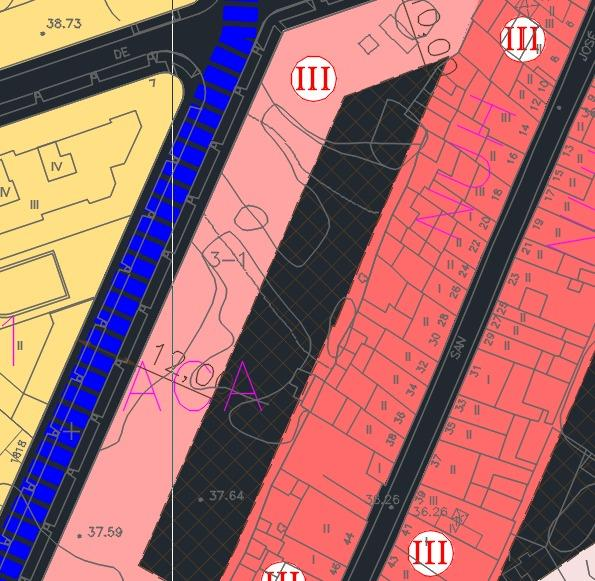
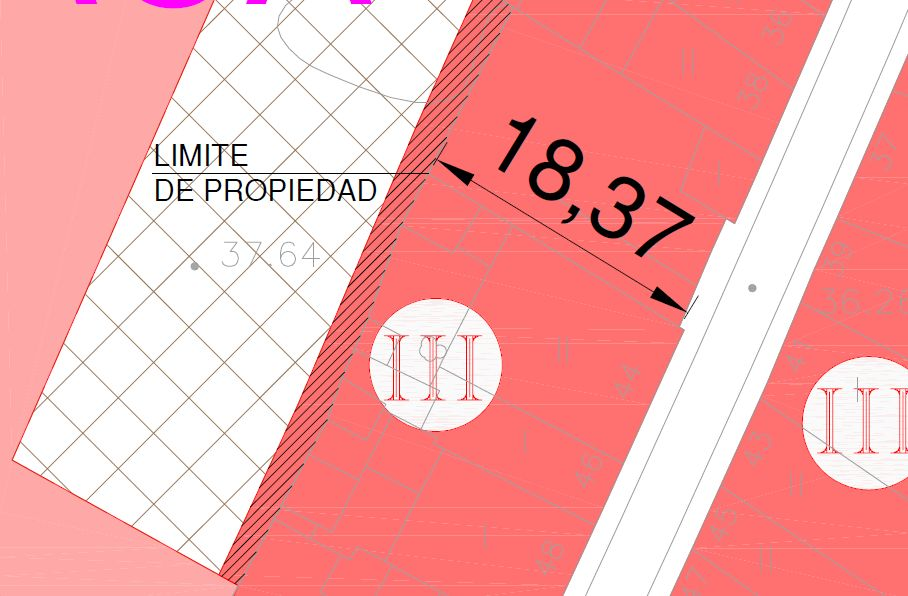
The «hatched zone» of the PGOU itself

These two images must be read together. In the first, the municipal plan itself identifies the hatched zone within the Calle Quijote plot and places it within the protected area. In the second, the plan detail highlights the property boundary and the width of the affected strip. Read together they reinforce that the Town Hall itself has been recognising that strip as part of the protected scope tied to the historic centre.

Detail of plan OP8. The hatched zone appears within the plot and in continuity with the protected area.
Enlargement of the property boundary. The drawn strip and its direct relation with the Calle Quijote plot are highlighted.

The neighbour critique is that this protection blurs precisely for this developer. According to the residents' interpretation, removing that strip from the protected area avoids the need to carry out the mandatory archaeological surveys that would otherwise be required if the drawn protection were kept.

What is at stake

  • 01

    Calle San José is the origin of the municipality, with over 500 years of history.

  • 02

    Its neighbours were the farmers of the Huerta, those who cultivated the Fondillón vineyards.

  • 03

    The affected plot is crossed by 16th-century hydraulic infrastructure.

  • 04

    The Huerta de Alicante is a recognised cultural landscape with 150 catalogued buildings.

  • 05

    MP25 was processed in ~60 days. The street has been standing for over 500 years.

«We are not defending stones: we defend a living cultural landscape, made of inhabited houses, of channels that still water the fields, and of a street that is the origin of this town.»

Calle San José Residents Association

500 years on a line

3rd c. BC

Foundation of Lucentum (Tossal de Manises), Roman origin of Alicante

8th c.

Al-Laqant: Benialí is born.

1247

Christian conquest of Alicante by Alfonso X the Wise

1296

James II incorporates Alicante into the Crown of Aragon

~1510

First houses of Calle San José next to the Huerta path

1580–1594

Construction of the Tibi Dam, pioneering engineering in Europe

16th c.

Documentation of the Hijuela de Mingot under Quijote 12

1609

Expulsion of the Moriscos: demographic blow to the Huerta

1644

Berber raid on the coast: reinforcement of the Huerta Towers

1691

French bombardment of Alicante by Louis XIV's fleet

1696

First graphic representation of Calle San José

1709

Blowing up of Santa Bárbara castle (War of Succession)

1751

Plan of the Heredad de Benalí (Tower + San José chapel)

1858

Arrival of the Madrid–Alicante railway: start of transformation

1879

Santa Teresa flood: catastrophe in the Huerta

1956

American Flight: the Huerta before developmentalism

1968

Demolition of the San José chapel

1970s–2000s

Developmentalism: massive loss of farmland in the Huerta

2013

PGOU approves pedestrianisation of Calle San José (not delivered)

Feb 2024

Constitution of the Calle San José Residents Association

2025

MP21 reaffirms the ban on penthouses in the historic centre

Feb 2025

Public exhibition of MP25: grants the penthouse and shrinks the NUH

Main source

Martínez Salvador, E. (2012). «La Huerta de Alicante: pérdida de un paisaje cultural». GeoGraphos, University of Alicante. The article analyses the territorial structure of the Huerta, its heritage and landscape value, and documents the accelerated degradation of this cultural landscape.

Why it matters

Calle San José is a memory corridor connecting the Islamic origin of the town with the agricultural fabric of the Huerta and the daily life of 21st-century neighbours.

What is at stake with MP25 is not just a building: it is the protection line of six centuries of cultural landscape, and the trust in an administration that postpones indefinitely what protects the resident and approves express what benefits the developer.

Defending Calle San José is defending that the rules apply equally to everyone.

Why it matters

A historic opportunity for the new Sant Joan

Calle San José is not only an old street that should be preserved: it is a major urban opportunity for Sant Joan d’Alacant. Its location, human scale and connection with the historic core make it possible to imagine an attractive, safe and lively environment capable of revitalising not only this street, but the municipality as a whole.

As a pedestrian mobility axis, Calle San José can help connect the historic centre with the daily routes of families, children and older residents. Its role as a natural link between the municipality’s two schools reinforces a simple idea: Sant Joan’s future is not about keeping more heavy traffic in its historic streets, but about creating friendly, safe and healthy routes.

With vision, these streets can become some of the most desirable urban spaces in Sant Joan: places to live, walk, shop, meet and recognise the town’s identity. This is not about freezing the past, but about activating its value. A well-cared-for historic street can also be economically alive, culturally recognisable and highly attractive from an urban-planning perspective.

Calle San José can become a symbol of the new Sant Joan: a town that looks to the future without losing its past; that protects its memory and turns it into quality of life; that understands heritage not as an obstacle, but as a strategic advantage for better living, local activity and a more human town centre.

P.S.

Since you made it this far, you'll probably also want to…

— Residents of Calle San José

  1. 01See the full timeline
  2. 02Review the urban comparison
  3. 03Read the residents' objections